Welcome to our blog! Our trip to date has been a whirlwind. While this is only our 4th day on the project it feels as if we have been here for weeks. We were immediately able to begin working through different options for the project upon arrival. Our meetings stemmed from our first conversation with Nonny Wright, our partner in Maun, Botswana.
It has been a pleasure to meet Nonny and to hear her story. On our first day we had the opportunity to sit down and learn about how her business has developed over the last five years. The dairy business is challenging. We now have a better understanding that this is especially true in Maun. A particularly heavy drought this season is currently affecting the region, limiting milk production for farmers, and learning how to work with Nonny to grow her business despite these challenges is a significant element of what we will be doing during our SMART 2020 experience.

Cresta Maun
We stopped into one of the larger high end hotels on the outskirts of town and connected with a friend of our hotel manager. After quickly learning that Cresta Maun has a strong focus on cheap, quality, and local products we discovered that local implied within Botswana, not necessarily Maun. If there is an individual in the area that has a product of interest they were more than willing to try it out but they would have to work with the procurement team based in Gaborone. There seemed to be some interest when we inquired about the possibility of running a feature menu with a variety of items coming directly from Maun. This is an area where we believe Sereledi’s products could be a great fit, especially the madila as it is a local dish produced locally.

Maun Agriculture Office
What began as a series of small goose chases for representatives around town became a full-fledged panel incorporating members of agricultural research, animal production, agribusiness, marketing, and dairy production. We began with a brief history of how the cattle industry (largely beef, not dairy) has grown in light of an almost absolute culling in 1996-1997. We delved into how each sector works to support farmers including sourcing feed, government subsidies during drought, introducing new research to farmers, and connecting farmers to market. Maun is consistently facing a shortage of water and limited irrigation opportunities which hinders water-intensive production like dairy and even the development of more upstream sectors like fodder production to supply to livestock holders. One of the major challenges that we have continued to face in our conversations is the lack of attention given to dairy. Our host, Nonny at Sereledi Farms, is one of only two operating dairies in the region. However, our conversation highlighted developments that our host was hearing for the first time. One of the men who focused on dairy research was beginning to conduct work on feeding regimes for calves, which is a critical roadblock for Nonny who has faced difficulties in rearing calves past a certain age. Foot and mouth disease (FMD) is a huge focus which has impacted Nonny in terms of getting the correct veterinary support and diagnosis with her dairy farm cows. The veterinary office is so focused on preventing and monitoring FMD that they have very little availability to support Nonny’s diary business. During our final question on the future outlook for the dairy industry, the group mentioned a potential pilot project to introduce small-scale dairy to farmers throughout the region. The plan is to provide a few dairy cows to different farmers. Then, develop a collection and processing plant for the milk. Given Nonny’s experience in processing and her previously expressed desire to build a network of primarily young dairy farmers in the area, this seems to be a very interesting opportunity to follow-up on.
Choppies
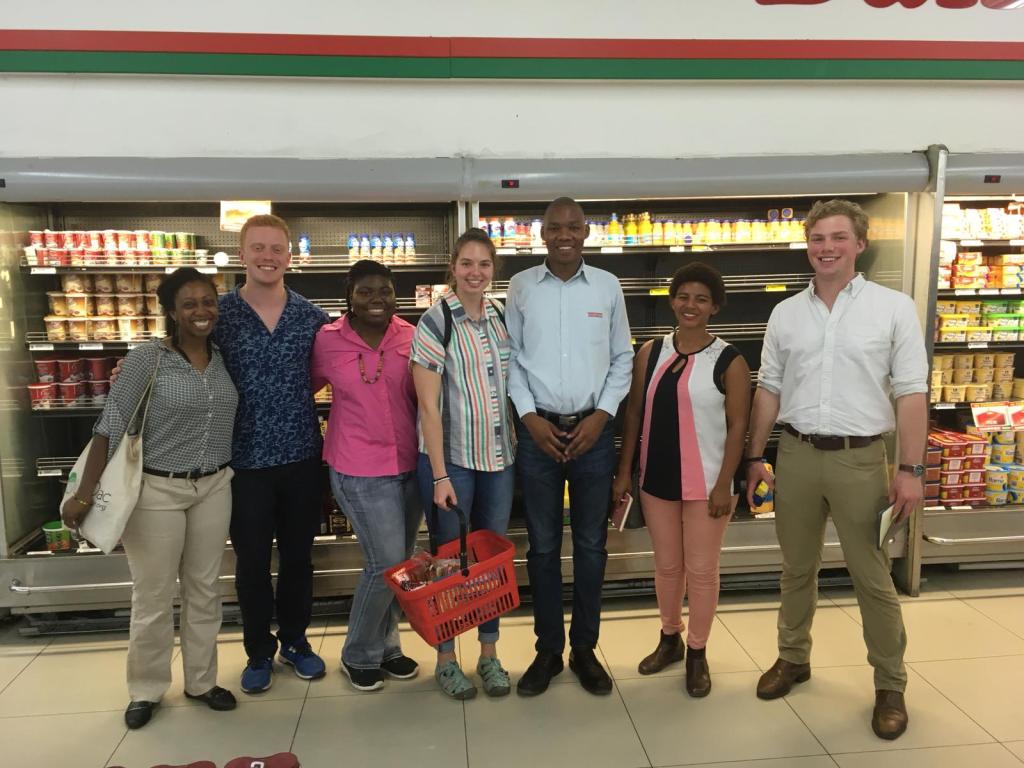
Choppies is a large multinational grocery based in Gaborone. We visited one of the four stores in Maun, just down the road from where we are staying. This discussion revolved around store procurement practices. He was able to provide some insight on what they are looking for in terms of quality and consistency. It was encouraging to meet with him and to learn about their willingness to work with local producers. One of the major challenges Nonny has faced has been delayed payments from contracts that have hindered her cash flow. Choppies maintains that it can reliably provide payments two days after delivery, particularly for small businesses, which would help a small producer continue to deliver and produce without extending a line of credit or giving up cash flow.

Woodsmoke
In a small back corner of Woodsmoke feed shop, our group eagerly piled around the store manager to discuss supply and procurement of the agricultural supply shop. He was candid and open about some of the challenges and limitations that his operation has as a private entity compared to the parastatal organization BAMB (Botswana Agricultural Marketing Board) that provides similar services. We’ve learned that although agricultural extension services exist in-country it is often the feed, seed, and medicine providers who provide the most information to farmers on the needs of their herds and businesses.
Water Affairs
Mr. Kgobero of the Water Affairs board was gracious enough to talk to us after we appeared on his doorstep, notebooks and all. Maun is facing a particularly serious drought, in an area that already receives little rain. On average, Maun receives 550mm of rainfall, but this year, rainfall barely broke 270mm. Most of the agricultural water comes from rainfall, which has become increasingly unreliable, and the Okavango water system which starts in Angola. Normally, the river is flowing and plentiful due to more frequent rains in Angola, however in this difficult year, even the river has dried up. Boreholes in this area are typically shallow (10-20m) because of the lack of bedrock, but that means they are very tied to the river. Once the river dries, the boreholes dry or become saline in nature. Neither of which is ideal for dairy production. Another complication within the local water industry is the placement of Maun in a conservation area. The Okavango Delta is protected by UNESCO as a World Heritage site which encourages strong protections in place around pollution to water sources. This can limit some industry and agriculture, however, there are efforts to create waste management programs to help encourage the collaboration and coexistence of industry, agriculture, and water safety and quality in Maun.
BAMB – Botswana Agricultural Marketing Board
A meeting at BAMB provided ample opportunity to gain insight into a government-supplied means of provisioning seed, feed, and medicine to farmers in and around Maun. We met with Mr. Jafta, who provided significant information on government subsidies during drought periods. In particular, he mentioned that animal feeds can be subsided from 25-35% based over a 6 month drought period. This means that BAMB can provide feed at very low prices to Farmers that need it. In addition, medical supplies can be obtained at BAMB. Because BAMB is a parastatal government agency that needs to source from local companies, it can be limited in its suppliers and not always have feed available. Temporary closures of Technofeed, their primary supplier, mean that feed can be delayed for weeks, which is especially crippling during the current drought period. BAMB is also on the cusp of facing some new competition from Technofeed, which will be opening a new retail location within Maun this year. One other complicating manner for farmers that rely on BAMB is that it does not provide dairy-specific medicine, which reflects the low dairy production presence within Maun.
Kings
On day six, we visited Kings market and spoke with the supervisor. Kings has been a loyal customer of Sereledi Farms and has sold strawberry and banana drinking yogurt for the past two years. Kings’ main customer demographics who purchase drinkable yogurt are orphans and mothers who buy for their children. Orphaned children are able to use coupons, similar to SNAP benefits to purchase the yogurt. The supervisor of Kings mentioned that her customers are requesting Sereledi because they like the thick texture. Sereledi drinking yogurt has been compared to a drinkable yogurt made in Namibia. In terms of pricing, the supervisor of Kings said she chooses the price of products based on the product quality. My team was very excited to hear that Sereledi drinkable has such high quality that she is able to mark up the price by 30%.
 SMART 2020: Botswana